


Evolution of Urban Planning in Lisbon
In 1938, Lisbon City Council, under the chairmanship of Duarte Pacheco, hired the architect-urban planner Étienne de Gröer who, together with the municipal technical services, defined the main lines of development for the city. In 1948, the plan was completed and approved by the CML, although it never received government approval. The main instrument of the plan was zoning, dividing the space into areas with different uses, to which specific legislation applied. The main thrusts of the plan were:
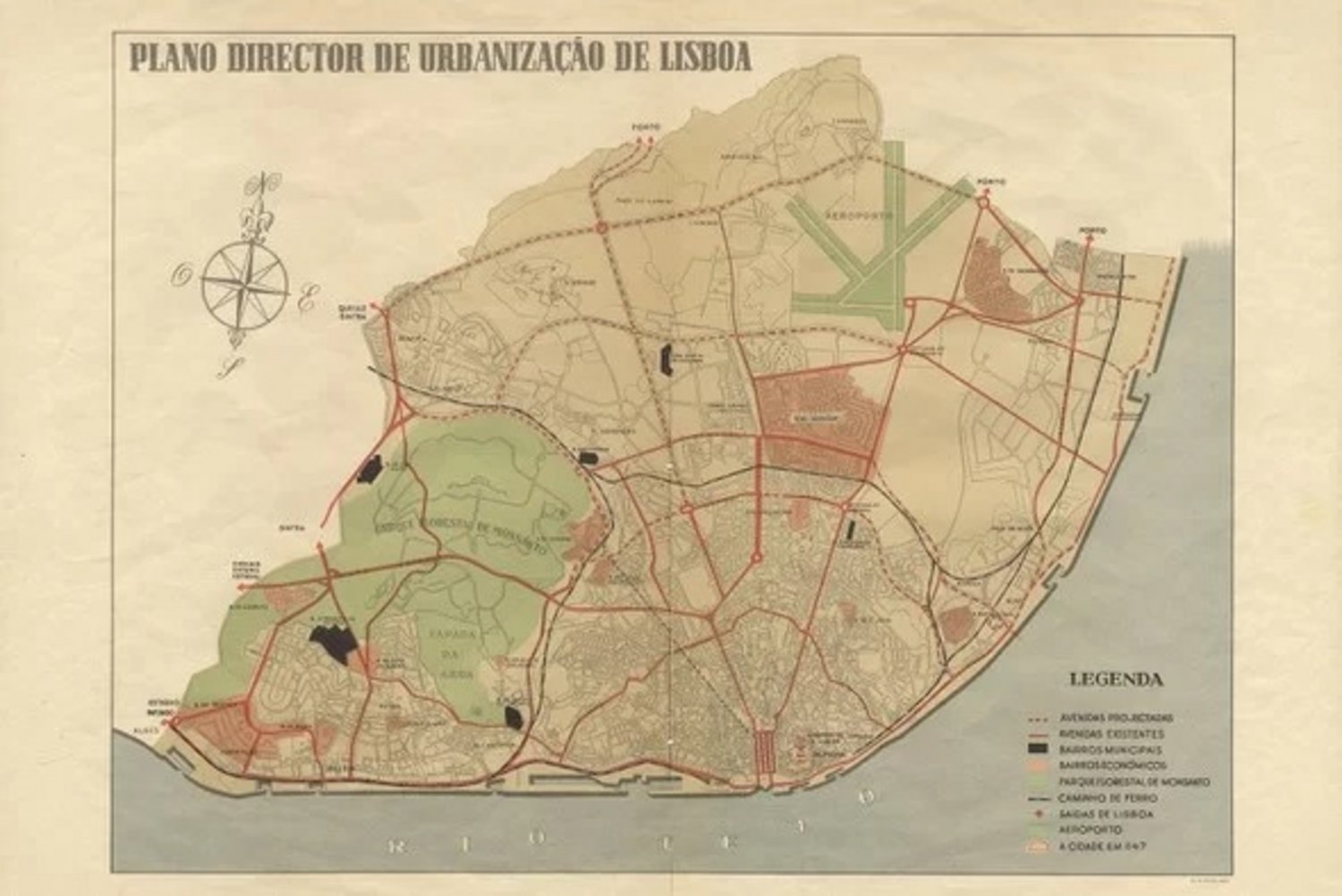
- Creation of a radio-concentric road network based on an axis consisting of Av. A. Augusto de Aguiar and its extension to the Lisbon-Porto highway
- Organize decreasing population densities from the center to the outskirts
- Create an industrial zone in the eastern part of the city, associated with the port
- Building a bridge over the Tagus at Poço do Bispo-Montijo, linked to one of the ring roads
- Build an international airport in the northern part of the city
- Create a park in Monsanto with around 900ha, and a green zone around the city that would include Monsanto Park and extend through the Loures floodplain to the Tagus River
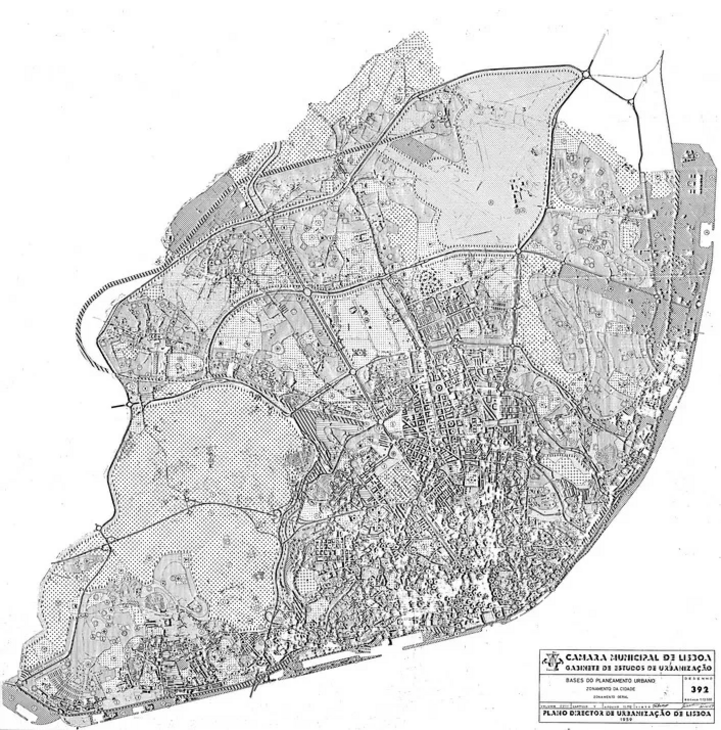
In February 1954, CML created the Urbanization Studies Office (GEU) with the aim of reviewing and updating the 1948 Plan. The Lisbon Urbanization Master Plan (PDUL) of 1959 kept most of the proposals of the previous plan, although it introduced important changes. These included the construction of a bridge over the Tagus from Alcântara to Almada, a highway bypassing Monsanto Park (from Alcântara via Campolide to Buraca) and the construction of two highways, one to the north and one to the south following the bridge.
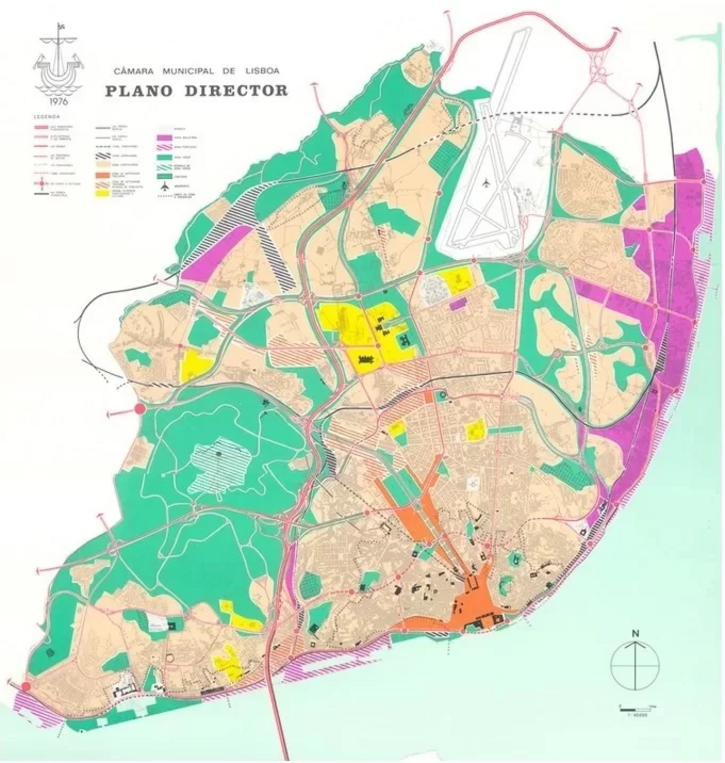
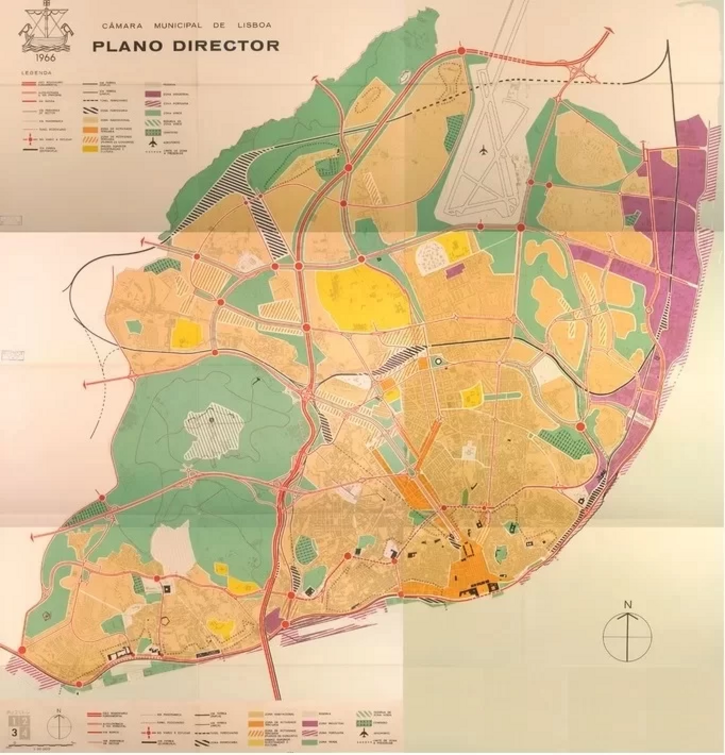
Its drafting was due to the need for an instrument that would fit in with the new urban reality, namely the increase in car traffic, the start-up of the metro network, the construction of the Tagus Bridge and the beginning of the process of tertiarization of the city center and the growth of the city's outskirts. Following these results, CML decided to commission architect-urbanist Meyer-Heine to revise the PDUL. This resulted in a spatial planning instrument covering the entire area of the municipality, which was drawn up between 1963 and 1967, but only published in 1977, with some changes (Ministerial Order no. 274/77, of May 19). The main guidelines of this plan were:
- Creation of a distributor axis, supported to the north and south by the northern highway and the bridge, passing through the airport
- Extension of Av. da Liberdade as a major monumental axis but with highway functions as in the previous PDUL, with the aim of decongesting Baixa and creating a new hub that attracted traffic away from the center, Alto do Parque
- Division of the city into "basic planning units", known as Territorial Planning Units (UNORs)
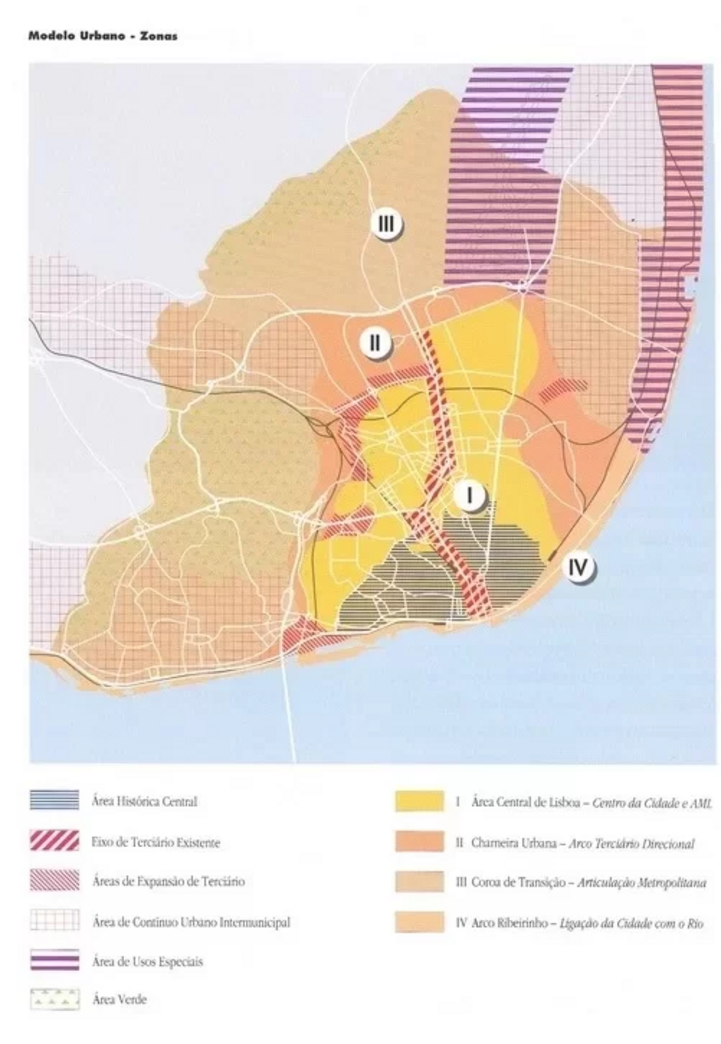
The acceleration of urban transformations and social changes in large metropolises and cities has deeply questioned the planning methods and processes used throughout the 1940s and 1970s. In this context, in 1990 the CML approved the bases for drawing up the Strategic Plan and the Municipal Master Plan. This proposal defined the guiding principles of the planning process and the priority objectives for Lisbon.
The Lisbon Strategic Plan (PEL) was approved by the City Council on June 9, 1992 and was an important long-term instrument - 10 years - to support decision-making, with the aim of establishing the guidelines for municipal action towards the planning and development of the city, and also the establishment of a "contract" of shared responsibility with the entities, agents and organizations, from the public and private sectors, that operate in the city.
The Municipality of Lisbon has developed a planning system using various urban planning instruments, in conjunction with the PDM, which has defined technical and regulatory support. The methodology for revitalizing Planning in the Municipality of Lisbon was thus envisioned (February 1990), a task that was facilitated by the then new regulations on Municipal Master Plans - Decree-Law no. 69/90, of March 2.
Based on the cross-referencing of the city's weaknesses and potential in the PEL, the following main strategic objectives were established:
- To make Lisbon an attractive city in which to live and work
- Make Lisbon competitive in European city systems
- Reaffirm Lisbon as a capital metropolis
- Create a modern, efficient and participatory administration
These objectives, which were intended to allow the city to undergo profound transformations and project itself adequately into the future, presupposed overcoming serious shortcomings that existed at the time, especially in terms of housing and urban infrastructure, as well as an effort to upgrade some of its public spaces, in order to improve the quality of life of residents.
The central objective was to make Lisbon a 21st century city, in other words, a more humane and modern city. In order to achieve this, it was necessary for the local government to translate the "city project" into an urban planning model for Lisbon. The planning model of the 1992 Lisbon Strategic Plan was, at the time, an innovation in the models of European strategic plans, of a socio-economic nature, which, in the case of Lisbon, integrated a spatialized urban model differentiated into 4 areas or territorial units with some homogeneity, arising from specific problems and potential:
I - Lisbon Central Area - the city center and the AML
II - Urban Belt - Directional Tertiary Arc
III - Transitional Crown - Periphery with Metropolitan articulation
IV - Riverside Arc - Connecting the city to the river without losing the port
Two important structures were also created to implement the 1st Lisbon Strategic Plan: the Plan Council, made up of representatives of institutions, agents and operators, to further its development and review it when necessary; and a Development Agency for the Modernization of Lisbon's Economic Base (AMBELIS).
The Lisbon Strategic Plan had a target date of 2000. It should be noted that in the last decade, Lisbon has undergone significant changes in terms of the level of sanitation infrastructure, the road network, the green structure and selective collection of the urban solid waste system, the provision of some public facilities, namely leisure facilities, and, fundamentally, with the important requalification operations in the riverside area, carried out by the Port of Lisbon Administration, and in the eastern part of the city, as a result of the 1998 World Expo.
The 1994 Municipal Master Plan established the rules for the occupation, use and transformation of the municipal territory, and was fundamentally a support document for urban administration. It was drawn up within the framework of Decree-Law 69/90; it sought first and foremost to translate the urban planning options and concepts formulated within the framework of the 1992 Lisbon Strategic Plan.
The following fundamental urban concepts of the PDM were considered:
- The concepts contained in the model based on the four planning areas, defined in the strategic plan
- The concepts of the transport system
- The principles for planning tertiary activities
- The green structure for Lisbon
- The concept of nuclei of historical interest and built heritage contained in the municipal heritage charter
The 94 PDM Regulation also sought to respond to the urban strategies for Lisbon defined in the previous PDM studies:
- Revaluing the housing function in the city as a whole, and particularly in its central area
- Stabilization of the consolidated urban complex, with priority given to the central area of the city
- Rehabilitation of the functional/tertiary structure and development of new centralities
- Reconversion of the eastern industrial zone for advanced industrial support services and the development of Lisbon's logistics platform
- Enhancing Lisbon's environmental quality
- Improving accessibility/mobility in the central area of the city
It was primarily a reactive plan to the tertiarization that the city had undergone in recent decades/years. It was also a classic zoning plan that aimed to protect housing as the dominant function, while also reacting to the growth of the city through subdivision operations.
The 1994 PDM was based on the cascade planning system as a way of consolidating the city, and initiated a first generation of urban rehabilitation policies, with the delimitation of historic housing areas and the historic central area of Baixa.
In terms of mobility, the 1994 PDM abandoned the idea of extending the central axis of Avenida da Liberdade and maintained the radio-concentric circulation system that had been in place since the De Groer Plan; it created the Monsanto/Parque Eduardo VII green corridor and also instituted the protection of environmental and landscape values for the first time, namely the system of views, and cultural assets, such as the Municipal Heritage Charter, integrated into the PDM Regulations (Municipal Heritage Inventory).
The 1994 PDM was approved by the Municipal Assembly on May 26, 1994 and ratified by the Government on July 14 of the same year through Council of Ministers Resolution no. 94/94, published in Diário da República no. 226, I Série - B, September 29, 1994.
More information:
Framework Report
The process of preparing the Strategic Vision began in May 2002, with the drafting of the Terms of Reference and monitoring of the preliminary study entitled "Materializing the Strategic Vision for the City of Lisbon", in collaboration with McKinsey & Company, with Prof. João Ferrão as external consultant.
The Strategic Vision followed on from the previous Strategic Plan (1992) and was intended to be a benchmark for the executive's policies, having been drawn up in parallel with the start of the 1994 PDM Revision work. Using the methodology and basic values of traditional strategic planning, it was decided to objectively define a reduced set of key ideas and structuring axes that embodied what was called a Strategic Vision for the city.
This was not really a Second Strategic Plan for Lisbon, as its preparation would have required greater involvement from the main economic and social agents and sectors, both public and private, through a joint working methodology, in which the necessary consensus is developed around the selection of projects and the respective programming and financing of the actions to be undertaken, in the context of shared leadership and established cooperation mechanisms between all the agents and institutions involved in a Planning Council.
It is also worth noting the absence of a Participatory Council structure in the city of Lisbon, whose creation proposal (Proposal no. 541/2002 approved by the CML in 2003/02/05) was not approved by the Lisbon Municipal Assembly.
It should also be noted that, in view of the new framework provided by the Law on the Basis of Territorial Planning and Urbanism Policy (LBPOTU, Law no. 48/98, of August 11), the Municipal Master Plans now embody the local development strategy, which meant that it was no longer considered imperative to draw up a Second Strategic Plan.
In this context, the Strategic Vision - Lisbon 2012 systematized the strategic planning process in Lisbon, developed from 2002 onwards, and was intended to be a forward-looking document regarding the conduct of local spatial planning policy and the city's urban development. The fundamental idea was to develop a document that would guarantee the coherence of the city's urban development axes and the permanence in time and space of some structuring municipal policies, avoiding development obstacles resulting from the change, with the change of mandates, and consequently of the values and policies that supported the city's basic strategy.
The Strategic Vision for Lisbon 2012 aimed to qualify and modernize the city and project Lisbon to the highest positions in the ranking of the best cities to live, work and invest in, and is supported by four Urban Development Axes:
- Lisbon, City of Neighborhoods
- City of Entrepreneurs
- City of Cultures
- City of Modernity and Innovation
The urban intervention strategy along these axes of development was based on strategic guidelines and actions covering various themes and social, historical, cultural, environmental, economic, technological, etc. dynamics. Although the analysis is carried out separately, it was not intended to dissociate the objectives underlying the four axes, with the interventions taking on a transversal character to be conducted in an integrated manner.
From the definition of the Mission and Development Axes, to the production of recommendations and strategic guidelines in different areas and the drafting of planning measures and actions, it was widely participated in, through the adoption of a participatory methodology (twelve thematic workshops of focused participation) and the promotion of various meetings and discussion forums relating to the Revision of the Municipal Master Plan. The contributions and opinions recorded were very useful for outlining sectoral measures and strategies in the different areas of urban development.
The Lisbon Strategic Charter aims to respond to the current challenges in city planning. To envision the future, planning and realizing what we all want for Lisbon today.